Monday, August 30, 2010

Author Guest Post: Holly Kearl on Stopping Street Harassment

0 comments
Nearly four years ago when I had to select a master’s thesis topic at George Washington University, I thought about all of the times men I don’t know have harassed me in public.

Men have whistled and honked at me, hissed and made kissing noises, made degrading and sexually explicit comments, followed me, and one man even groped me. The harassment has not been specific to any one location and has included: on a rural road in Oregon, at a gas station in Utah, near the beach in southern California, a block from my college campus in northern California, on the New York City subway, in a park in Virginia, on the mall in Washington, DC, downtown Brugge, Belgium, and in a neighborhood in Lancaster, England.

I thought that dealing with and trying to avoid harassers was my lot in life as a woman. Then I came across websites like HollaBack NYC which empower women to share their harassment stories and call out the men who did it. I realized other women did not like this unwanted attention and harassment. I began researching it and became empowered to realize I did not have to stand for this behavior!

I chose to write my master’s thesis on street harassment, particularly how women were using online methods to deal with harassers in lieu of legal remedies. My thesis struck a chord and was featured on CNN. Soon after that in 2008, I founded the Stop Street Harassment website and blog; women around the world share their stories on the latter. Then I started working on a book and signed a contract with Praeger last year.

I wrote my book Stop Street Harassment: Making Public Places Safe and Welcoming for Women (Praeger, 8/2010) across five months, mainly last August - December. What struck me the most as I wrote was how worldwide this problem is and how many people in just the last five years have started to address it. I corresponded with activists in India, Egypt, Canada, Australia, Mauritius, and Colombia, in addition to activists across the United States in California, Georgia, Illinois, Massachusetts, New York, and Washington, DC. So much activism was occurring that even though I had most of my research completed when I signed the contract, I had to keep researching and revising to make sure I was as thorough and current as I could be.

Once I turned in my book proposal in January of this year, I lost the ability to be totally current because activism – thankfully – continued to blossom worldwide. The United Nations published a 100 page document about how to make cities safer for women and anti-harassment campaigns took off in England, Wales, Bangladesh, and Lebanon. I am thrilled by their work, but I also regret not being able to include them in my book!

My international take on street harassment and my action-oriented suggestions for ending it make my book unique among the handful that already exists on this topic. While I offer suggestions for large-scale activism, at the end of the day, what I really hope is that everyone who reads it will take at least one form of individualized activism. Every action can make a difference and all the actions together can help change the cultural acceptance of street harassment.

At an individual level, we can all talk and learn about street harassment because problems that are ignored stay problems. Share stories, ask women you know about their stories and how it’s impacted their life. Intervene when you see harassment occurring and report harassers, teach boys to respect women, and empower girls to know how to deal with harassers. No action is too small and the responsibility lies with each of us to make public places safer for everyone.

--Holly Kearl, author of  Stop Street Harassment: Making Public Places Safe and Welcoming for Women

Author Holly Kearl is a national street harassment expert and nonprofit professional based in the Washington, D.C. area. Her work has been cited by the United Nations, CNN, the Guardian, Canada.com, Feministing, and Jezebel. In addition to her book, she runs the website Stop Street Harassment and the companion blog where people from around the world submit their street harassment stories. Kearl has written articles about street harassment for Forbes.com, Huffington Post, Oregonian, and AOL. She also works for the women’s equity nonprofit AAUW.
Follow Holly on Twitter.
Become a fan on Facebook.

Friday, August 27, 2010

Coming Up Next Week...

0 comments

Wednesday, August 25, 2010

ABC-CLIO Launches 12 New Databases for Higher Education

0 comments

The launch of our new collection of databases for higher education reflects ABC-CLIO’s commitment to creating a new, student-centered resource genre that answers new needs for research and learning in a digital world. We have integrated core, essential reference content, innovative teaching resources, and thoughtful coverage of the enduring questions that are part of history and the humanities into each of our 12 databases. Each database makes important linkages, connecting the library, course texts, and classroom to support enhanced student engagement, authentic understanding, and powerful research skills. With thousands of primary and secondary sources, fluid navigation, continually updated content, and the noteworthy contributions of scholars, educators, librarians, and subject area specialists, these databases are redefining research for students and educators alike. 

ABC-CLIO offers the following new academic databases:

•    American Government
•    American History
•    Issues: Understanding Controversy and Society
•    World Geography: Understanding a Changing World
•    World History: Ancient and Medieval Eras
•    World History: The Modern Era
•    World at War: Understanding Conflict and Society
•    The African American Experience
•    The American Indian Experience
•    The Latino American Experience
•    Daily Life through History
•    Pop Culture Universe: Icons, Idols, Ideas

To sign up for a free preview, click here.

Monday, August 23, 2010

Guest Post: Nike Inspires Author to Overcome Hurdles

0 comments
It’s a bit ironic that writing a book about a company that has transformed the sports industry could actually become a life-changing experience for the author. However, such was the case for me when I was writing Nike as part of ABC-CLIO’s series on Corporations that Changed the World. It was easy enough to select a company that is continually reinventing itself with new products and forever leaving an unmistakable mark on not only the sports industry, but also society in general. As I was gathering comments from top-name sports professionals and conducting research to determine why Nike has become so legendary, I learned a valuable life lesson. The road to a specific destination is often interrupted with unexpected twists and turns. The manner by which we navigate these obstacles is a true test of our character and can prepare us for our next journey.

As I wrote the final sentence to complete Nike, I realized I had achieved a personal milestone that could inspire readers. The milestone was not simply because I had written a book that required significant research and perpetual vigilance to stay in tune with Nike’s technology team as it cranks out products at a lightning-fast pace. I’m much too modest to just reflect on the book itself.

The high point for me was being able to complete the book at a time when life had blindsided me with a serious health issue. There were times when I thought I would never be able to meet my deadline, but I kept hearing three words over and over. “Just do it.” Most of you are familiar with the “Just Do It” advertising campaign that landed Nike a permanent place in the Smithsonian Institution. However, few of us have probably been able to incorporate the words into our own lives. As a teenager, I was inspired by every catch phrase that was aimed at making consumers feel invincible. Yet, I had long since forgotten about the “Just Do It” campaign until I embarked on the Nike project. I certainly never imagined the phrase would ever serve as a source of motivation for me to write a book about this incredible company. 

Sports celebrities like Adrian Peterson of the Minnesota Vikings and Steve Nash from the Phoenix Suns made my job easier by being very accommodating in terms of answering my questions. Their responses about how Nike has inspired them were quite interesting and compelled me to be relentless in telling the story of how the company’s co-founders initiated their dream with a mere handshake. Of course, I did not realize as I was writing the book that I had something in common with the founders. In fact, completing the project while in the midst of what could have been a health catastrophe required me to exercise the same determination they used to propel their company to the top.

Fortunately, I have recovered, but the road was difficult. My book will forever be a reminder of the resilience of the human spirit and the indomitable power of focusing on a goal. Nike co-founders Phil Knight and Bill Bowerman epitomized this spirit when they refused to let naysayers thwart their dreams. Their persistence paid off tenfold with the creation of a company that continually outpaces its competitors by utilizing the most modern technology, developing the most innovative products, creating the most remarkable advertising campaigns, and endorsing the most well-known, and sometimes controversial, athletes.

It is my hope that the story of Nike will unleash the necessary passion to help readers pursue their own dreams. Writing the book was a saving grace that has made me a firm believer in another less popular, but just as profound, Nike catch phrase – “There is no finish line.” Each project and every experience should be considered stepping stones not to the end, but to our next journey because there truly is no finish line. There is always one more hurdle to surmount.

--Tracy Carbasho, author of Nike (Greenwood, 8/2010)


Tracy Carbasho  is an award-winning journalist who has published articles in newspapers and magazines throughout the United States and the United Kingdom. Tracy has always enjoyed writing so much that her favorite gifts as a child were notebooks and pens. Nothing has changed. In fact, friends and relatives often joke that it is extremely easy to buy presents for her. It's rare to see her without a notebook in her hand because she never knows when an idea for an interesting article or book may occur.

When she's not busy writing articles for business publications and legal journals, she relaxes by spending time with Mojo, her 100-pound Australian Shepherd/Husky mix. Her idea of the perfect future is to one day own enough property to provide homes for numerous rescued animals.

Friday, August 20, 2010

Coming Up Next Week. . .

0 comments
  • Tracy Carbasho guest blogs about her brand-new book, Nike.
  • A look at ABC-CLIO's latest digital products
...and more!

Tuesday, August 17, 2010

Interview: Selena Rezvani on the Next Generation of Women Leaders

0 comments
Interview with Selena Rezvani, author of The Next Generation of Women Leaders: What You Need to Lead but Won't Learn in Business School (Praeger, 12/2009)


Q: Selena, what is the number one issue women face in today's workplace environment?

A: There’s a commonly held belief that we’ve reached gender parity—particularly because women now make up half the workforce. This is not true. All one needs to do is look at the low numbers of women actually leading businesses―acting as decision makers―to know that progress has stalled. One of the biggest barriers women face is this very misconception. 

Q: What are a few things a woman can do to help her succeed in the workplace?

A: Don’t think that anyone else will ever move your career forward. You need to drive, sculpt, and create your career, taking 100% ownership. Realize that good work does not guarantee rewards. To move up, you need a combination of results and self-advocacy. Good old-fashioned negotiation skills shouldn’t be underestimated. We know that women are four times less likely than men to initiate negotiations, so investing in training in this area early in your career can make all the difference.

Q: So, what makes your book stand out among other books on this topic?

A: No else has written a book on women and leadership that focuses on the woman in the first half of their career. While there are many terrific books on women and leadership, they tend to take a broad-brush approach, treating women at all different stages exactly the same. My book helps a woman get off to the right start, navigating the tricky aspects of having less formal authority and positional power than her more established counterparts.

Selena Rezvani's 5 Need-to-Know Facts for Success
  1. Be aware of the verbal and non-verbal language you use to convey your ideas and make sure that you’re not inadvertently diminishing credibility instead of building it. One example is getting rid of buffering your ideas, with phrases such as, “This might be a silly idea…” “Someone else may have already said this…” and “Sorry if this has already been said…” 
  2. Consider taking career risks before you feel ready for them. You will often surprise yourself, performing better than you think you would.
  3. Create a personal board of directors whom you can go to for different needs, such as help with image, technical skills, or community contacts. Rarely can one mentor satisfy all your needs.
  4. Actively create a leadership brand for yourself. Remember that within every single interaction at work, you’re modeling for others what you think of yourself and how you’d like to be treated. 
  5. Use your values as a career compass—they will never steer you wrong. 

    Selena Rezvani is an author, speaker and consultant focusing on women and leadership. When she’s not working with clients or writing her column for The Washington Post, she’s exploring her favorite city, Philadelphia. To learn more about Selena, visit www.nextgenwomen.com. You can follow her on Twitter @nextgenwomen or join her Facebook fan page to stay in touch. Selena will be a guest speaker for an event through Young Girl's Network in Cherry Hill, NJ on Wednesday, August 18. She will be discussing "5 Strategies for Taking Control of Your Own Success." You can see Selena's full list of upcoming appearances here.

      Friday, August 13, 2010

      Author Guest Post: Stories on Board! with Dianne de Las Casas

      0 comments
      I grew up playing board games.

      I love how board games not only bring people together in a spirit of fun competition, but they also allow people to spend time together, sharing both chagrin and laughter as the game pieces move around the board.

      One day, as I was rewriting a favorite folktale, the idea hit me. I could combine my favorite folktales and my love of board games into a fun, educational method that encompasses reading, writing, math and social studies. Stories on Board! was born. On a chilly, windy day in February at Pensacola Beach, Florida, I was inspired and furiously typed out the method on my laptop, right on the beach!

      Meinard Cruz from Scholastic Book Fairs Philippines has been a longtime client and now, friend. He asked me to come to the Philippines and give workshops to teachers there. I was delighted when he agreed to let me debut Stories on Board! with the teachers in the Philippines. The workshop was a smash hit. The teachers loved the technique and are now using the method with their students.

      4th graders playing "Don't Get Trapped"
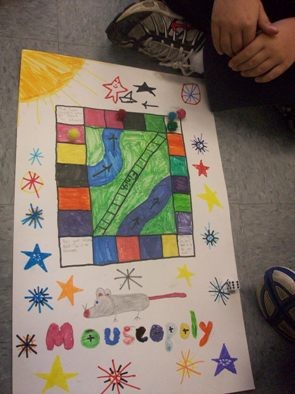
      Here's how it works: students in one class are given a favorite folktale. As a class, we break down the story, analyzing the characters, the perils, and the triumphs of the story using my signature “storymapping” technique. Then the students are shown examples of various types of board games and match the perils and triumphs of the story with the perils and triumphs of a board game. The students are put into groups of 4-6 people, working as a team to create a game board for the story they were assigned. There is a lot of spacial planning, simple math, collaboration, cooperation, and communication during the creation phase of the board game. When the games are completed, they play! I use this method with grades 3 and up. With the lower grades (PK-2), they play a game that I create from a story.

      I used the technique in a two-week residency at one of my favorite schools in Louisiana – Bissonet Plaza Elementary. The students loved the fun they were having creating the board games. The teachers loved how much instruction and learning was involved. Game Day was done during P.E. time and the P.E. teachers enjoyed it so much they asked to keep several of the student-created games to use on rainy days.

      Mouseopoly, created by a team of 5th graders
      I am amazed by the creativity and teamwork I witness when students create their board games using the Stories on Board! method. They have a sense of pride because they create their own game. Surprisingly, many of the students I work with have never even played a board game! It is a pleasure to see students laugh and encourage each other during the games.

      Since then, I have taught this method in professional development workshops and in schools across the country. Thank you to the countless teachers and librarians who understand the educational value of board games.

      Stories are… fun and games! Let’s play!
      --Dianne de Las Casas

      Click here for more information on Stories on Board!: Creating Board Games from Favorite Tales (Libraries Unlimited, 5/2010).


      Dianne de Las Casas is an author and award-winning storyteller who tours internationally, presenting programs, educator/librarian training, workshops, and artist residencies. She is the author of many books, including the Libraries Unlimited titles Scared Silly: 25 Tales to Tickle and Thrill; Tangram Tales: Story Theater Using the Ancient Chinese Puzzle; Handmade Tales: Stories to Make and Take; and The Story Biz Handbook: How To Manage Your Storytelling Career from the Desk to the Stage.